Related

Knee Pain and Compensations in Hockey Players and Goalies
Knee pain shows up all the time in hockey. Skaters deal with it. Goalies deal with it. The demands of skating, cutting, loading, dropping into the butterfly, and recovering back to your feet all place a lot of stress on the knee joint. But one thing I remind athletes of all the time is this: knee pain is rarely just a knee problem. It is usually a sign that something up the chain or down the chain is doing too much or too little.
In this breakdown, I want to walk you through two of the most common knee compensation patterns I see in hockey players and goaltenders. These patterns influence everything from stride power to stability to long term knee health. We will also go through strategies and exercises you can use to address them, using a combination of scientific insight and what I see clinically every day.
Why does this matter? Because when the knees track cleanly, you produce force better. You absorb force better. You move with more confidence. And you avoid the constant irritation that can derail your training.
Before we get into the patterns, it is important to understand that some knee angle is normal. Humans naturally have a slight valgus angle because of how our hips and pelvis are shaped. Problems start when the angle is excessive, uncontrolled, or the only way your body knows how to move. So let’s talk about what is actually happening at the joint.
Understanding Knee Alignment: Valgus vs. Varus
You will hear two terms a lot: valgus and varus. Valgus is the inward collapse of the knee. Varus is the outward bowing. Neither is automatically bad. But when either one becomes your default movement pattern, that is when tissues start taking on stress they are not built for .
Valgus means the knees angle toward each other. In squat patterns or jump landings, it shows up as the knees caving inward. Varus means the knees angle outward. Standing, you might see a space between the knees. Moving, you might see a tendency to drive the knees away from the midline.
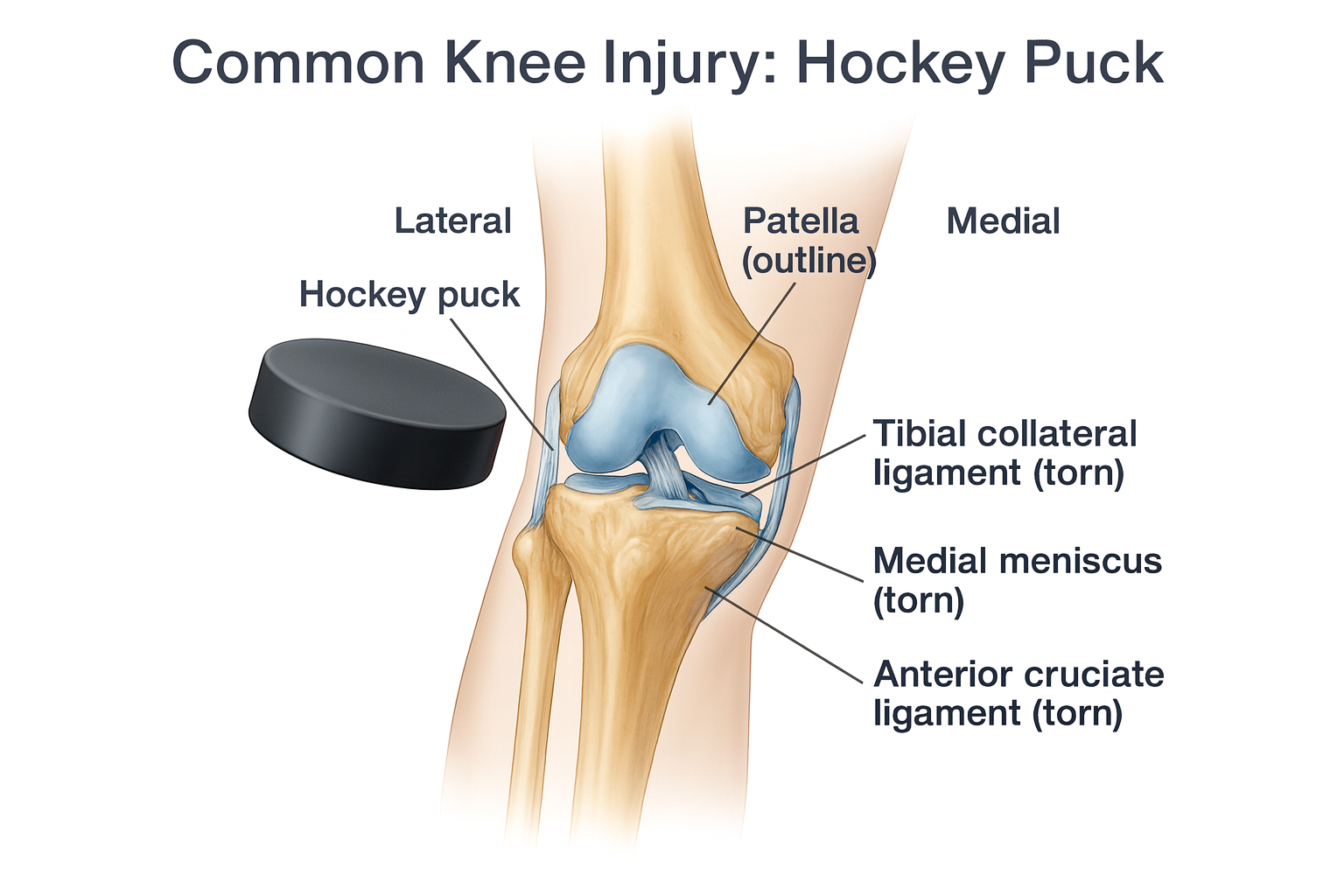
Both extremes load different parts of the knee. Valgus stresses the medial side, especially the MCL . Varus stresses the lateral side, especially the LCL . Over time, these patterns can irritate the joint surfaces and even compress the meniscus . The knee is built to hinge. When it is forced into rotation or angled loading too often, it lets you know.
With that foundation, let’s look at the two patterns that matter most for hockey players.
Pattern 1: Inward Knee Collapse (Knee Valgus Pattern)
This is the classic knee cave. You see it in squats, jumps, cuts, and even during skating strides when fatigue sets in. In goalies, it shows up during recoveries, shuffles, or when one leg pushes harder than the other.
Where it starts: Most of the time, the problem starts at the pelvis. Many hockey players sit in some degree of anterior pelvic tilt because of strong quads and hip flexors. When the pelvis tips forward, the femur naturally rotates inward . When the femur rotates inward but the foot stays pointed straight, the knee collapses inward . The knee ends up being the middle link in a chain that is being twisted from above and below.
This inward collapse affects several structures:
Medial knee stress.
The MCL and medial meniscus take on extra load . Chronic valgus is also part of the mechanism for ACL injuries. Research consistently shows that uncontrolled knee valgus and weak hip control drive ACL risk, especially in female athletes with larger Q-angles .
Patellofemoral pain.
When the femur rotates inward, the patella tracks laterally. This increases pressure under the kneecap and is strongly linked with patellofemoral pain .
Lateral knee irritation (IT band issues).
Valgus paired with external tibial rotation can stretch the outer knee structures. Research on runners shows this combination increases IT band friction .
So valgus is not just a visual issue. It affects how the knee absorbs and produces force.
Why hockey players fall into this pattern:
Strong quads. High skating volume. Forward-biased posture. Fatigued glutes. Years of lifting without cueing alignment. All of these reinforce anterior tilt and internal rotation. Goaltenders also hit this pattern when recovering from a butterfly if the hip and pelvis positioning is off.
Common signs:
Knees fall inside the foot during squats. Inside-knee soreness after games. Uneven blade wear on the inside edge. Kneecap irritation after practices. These are all clues pointing toward dynamic valgus.
Pattern 2: Outward Knee Drift (External Rotation / Varus Pattern)
This is the opposite issue. The femur is rotated outward relative to the tibia. The posture can look slightly bow-legged or “knees out.”
Where it starts:
This often comes from a posterior pelvic tilt. When the pelvis tucks under, the femurs naturally move into external rotation and abduction . Many players fall into this position as a way of dealing with hip tightness. Some goaltenders adopt it during deep stances.
The knee then ends up caught between an externally rotated femur and a tibia that does not rotate with it. That mismatch creates torque and a functional varus posture .
This pattern creates different problems:
Lateral patellar tracking and pain.
The outward femur pulls the patella laterally. This can cause pain on the outer knee and can contribute to long term patellofemoral degeneration .
Medial compartment overload.
Varus compresses the medial side of the knee . Over time, this increases risk for medial meniscus wear or arthritis .
IT band and LCL strain.
The outer knee structures take on more tension. Chronic friction can lead to IT band syndrome and increased LCL stress .
Why hockey players fall into this pattern:
Years of being told to push the knees out. Tight hips. Lack of internal rotation. Deep goalie stances. Trying to find butterfly range through knee rotation rather than hip rotation .
Common signs:
Kneecaps point outward. Weight sits on the outer edge of the feet. Trouble accessing hip internal rotation. Outer knee pain. Difficulty keeping the knee aligned over the foot during training.
Natural Anatomy vs. Dysfunction
A small amount of valgus or varus is completely normal. Every athlete has their own structure. The problem is when the body gets stuck. If the only way you can move is inward collapse or outward drift, that is when tissue stress increases.
Research shows that chronic off-center loading increases wear on the patellofemoral joint , contributes to persistent knee pain , and is associated with medial knee compartment degeneration in varus patterns .
Remember that the knee sits in the middle of the kinetic chain. A stiff ankle, restricted hip, or collapsing foot arch can all pull the knee into the wrong pattern . The knee is often just responding to whatever is happening above and below it.
Corrective Strategies and Exercises
Both patterns come back to the same idea: improve coordination of the pelvis, hip, knee, and foot. Restore the movement options that have been lost.
Below are targeted strategies for each pattern.
For the Inward Collapse (Knee Valgus) Pattern
Restore posterior chain engagement. =The 90/90 Hip Lift with ball squeeze teaches the pelvis to tilt back, activates the hamstrings and adductors, and reduces excessive internal rotation bias .
Strengthen hip external rotators and abductors. = Lateral band walks, clamshells, single-leg glute bridges, and split squats with a reactive band teach the knee to track cleanly .
Dynamic control work. =Staggered stance RDLs train the athlete to maintain alignment through hip flexion, which is where valgus often appears .
Core and trunk stability. =Planks, side planks, dead bugs, and Pallof presses help control pelvic and trunk motion that can pull the knee off line .
Movement retraining. =Intentional squat mechanics, drop jump landings, and skating-specific alignment work reinforce the new pattern.
For the Outward Drift (Varus / External Rotation) Pattern
Improve hip internal rotation mobility. =The 90/90 Hip Stretch is essential for players and goalies who lack IR .
Posterior chain activation in neutral. =Hook-lying bridges help build glute strength without reinforcing a pelvic tuck .
Pelvic rotation control. =Supine alternating cross-connect restores left-right pelvic movement and reduces rigidity.
Avoid over-cueing knees out. =Keep the knee aligned over the second toe, not pushed excessively outward .
Stretch tight structures. =The couch stretch, TFL soft tissue work, and adductor balance help restore hip mechanics .
Strengthen internal rotators. =Band-resisted hip internal rotation wakes up the smaller muscles that help center the femur.
General Advice for Both Patterns
Train the full chain. Strengthen the posterior chain. Improve hip and ankle mobility. Work on foot stability. Use single-leg balance drills. Listen to pain signals. Progress gradually. Build quality before quantity.
Conclusion
Knee pain is one of the most common issues I see in hockey players and goalies, but once you understand the mechanics behind it, the path forward becomes much clearer. The knee is usually the victim, not the culprit. Whether the pattern is an inward collapse linked to anterior pelvic tilt or an outward drift linked to a tucked pelvis and stiff hips, both can be improved.
With the right approach, you can restore missing movement options, improve strength in the right areas, and transfer that back into your stride, your butterfly, and your overall performance. Improvements in hip mobility or glute strength do not just relieve pain. They change how efficiently you move. Goalies with better hip internal rotation find their butterfly becomes easier and less stressful on their knees . Skaters with stronger hips and better alignment notice their knees no longer ache after a heavy game.
Once these patterns improve, blend them back into your skating, your edge work, your lateral movements, and your recovery mechanics. The goal is not just to fix pain. It is to move with more efficiency and longevity.
Take care of your knees by taking care of your hips, pelvis, and feet. When the chain works well, your knees feel and perform better.
References
Voelkel Feierstein, S. (2020). The Influence of Abnormal Hip Mechanics on Knee Injury: A Biomechanical Perspective. Physical Therapy First –
3D Muscle Lab. Valgus and Varus Knee Patterns and Knee Pain.
MSK Neurology (2018). Resolve Your Knee Pain by Addressing Its Alignment.
Relentless Hockey (Coach K. Kokotailo). Mobility Drills All Goaltenders Need to Be Doing.
Performance Redefined (C. Riley). Three Reasons Why Knee Valgus Occurs During a Squat (2022). –
.png)